The Calendar and Reminders apps look about the same as they did in iOS 26, but there are a couple of useful new Apple Intelligence features that make both apps more intuitive.
Natural Language for Calendar
Apple Intelligence in Calendar lets you add events by describing them in natural language. It identifies people, dates, and places while you are typing, and you can tap to add that info.
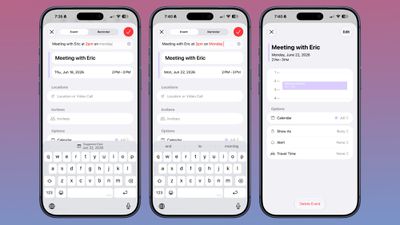
It’s not as fluid as Fantastical, but it’s better than before. You can’t just open the Calendar app and type “meeting at 2pm with Eric on July 14” and have it filed correctly as you do in Fantastical because it doesn’t have the same automatic date swapping.
Calendar adds an event on the date that’s selected, and by default, that’s the current date. To use natural language to select another date, you can type in “meeting at 2pm with Eric on July 14,” but you need to tap on the July 14 suggestion at the top of the keyboard.
The Calendar app will automatically set the event to the time that you type in with natural language, so you don’t need to tap for that.
Natural Language for Reminders
In Reminders, you can now describe a reminder in natural language and it will autofill the metadata that you mention. It can add date, time, and location automatically.
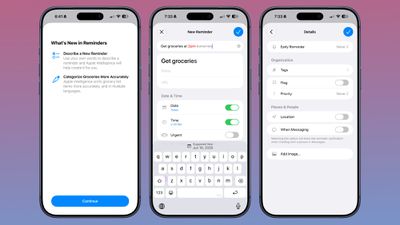
You can write in a reminder like “get the groceries at 6pm tonight” or “send the photos to John tomorrow at 4pm” and it will add the correct times to your reminder. The feature is in beta and it’s not entirely consistent, so sometimes you need to tap on the suggestion below to add the correct date and time, and sometimes it does it automatically.
With natural language support, Apple removed the menu bar at the bottom of the interface for adding a new reminder. Adding extra features like an image or metadata such as a flag can now be done through the “Details” interface.
Calendar Event Editing
The event editing interface is a little simpler to use, and it’s quicker to get to time adjustments. If you adjust the frequency of an event, Calendar can intelligently apply changes to all events. Siri can also be used for editing calendar events.
Holiday-Aware Alarms
The Calendar app tracks holidays, and can alert you the day before a holiday to ask if you want to change the time of the wake-up alarm that you have set.
The Calendar and Reminders apps both have a new extra-large widget size that takes up an entire app page.
Siri AI
Siri has full access to your calendar and can add events to it with natural language requests. What you can’t do with the natural language entry, you can do with Siri.
Siri is much more capable than before, and it does a better job correctly adding events to the calendar on the day and time you intend, and with parameters, like repeating events.
Just describe the event you want to create and Siri can get it done. Siri can add events to your calendar from other apps, like Mail and Messages.
Siri is able to search across the Calendar app and Reminders, so it knows your schedule and what’s on your to-do list.
Visual Intelligence
Visual Intelligence in iOS 27 supports adding multiple events to your calendar at one time from a schedule. If you have a document with a list of dates, like a child’s sports practice schedule, you can take a picture and add them to the Calendar app all at once.
<
h2>Reminders Grocery Lists
In iOS 27, the Reminders app has improved grocery list sorting. It also supports more languages than before.
Shortcuts for Reminders
There are new Reminders actions in the Shortcuts app, including Create Group, Create List, Create Section, Delete Groups, Delete Lists, and Delete Sections. There’s also a new “Get What’s On Screen” option that can be used with Reminders.
Apple Intelligence Requirements
To use the Apple Intelligence features in iOS 27, you need an iPhone 15 Pro or later.