The 2025 Women’s Rugby World Cup lands in England, and the Red Roses are chasing glory at the end of five thrilling weeks of rugby on home soil.
Finalists in all but one of the nine editions, two-time winners England are banking on home advantage to boost their conversion rate and finally break New Zealand’s stranglehold on the tournament.
The Red Roses, who kick the tournament off against the United States in Sunderland on August 22, start the competition as rugby’s top-ranked team, tournament favourites and having won the last seven Six Nations titles.
But the Black Ferns, back-to-back defending champions, remain the team to beat and arrive on English soil fearless, with five of their six World Cup titles won at England’s expense.
Women’s Rugby World Cup venues
Eight stadiums across England will host pool and knockout matches, culminating in the final at Allianz Stadium, Twickenham – the iconic home of English rugby and the host venue for the 1991 and 2015 men’s Rugby World Cup finals.
Allianz Stadium, Twickenham
Capacity – 82,000
Matches – Final and bronze final
Stadium of Light, Sunderland
Capacity – 49,000
Matches – Opening game
American Express Stadium, Brighton
Capacity – 31,876
Matches – Pool stage
Aston Gate, Bristol
Capacity – 26,462
Matches – Quarter-finals & Semi-finals
Sandy Park, Exeter
Capacity – 15,600
Matches – Pool stage & Quarter-finals
Franklin’s Gardens, Northampton
Capacity – 15,249
Matches – Pool stage
Salford Community Stadium, Manchester
Capacity – 11,404
Matches – Pool stage
York Community Stadium, York
Capacity – 8,500
Matches – Pool stage

The 2025 Women’s Rugby World Cup culminates at Allianz Stadium, Twickenham – the iconic home of English rugby
Pools and format
The tournament begins with 16 nations split across four pools.
Pool A – England, Australia, United States, Samoa
Pool B – Canada, Scotland, Wales, Fiji
Pool C – New Zealand, Ireland, Japan, Spain
Pool D – France, Italy, South Africa, Brazil
Following three round-robin fixtures, the top two teams from each pool will progress to the knockout stage.
Women’s Rugby World Cup 2025 schedule
Pool stage
Pool A
August 22: England vs United States – Sunderland, 7.30pm
August 23: Australia vs Samoa – Salford, 12pm
August 30: England vs Samoa – Northampton, 5pm
August 30: United States vs Australia – York, 7.30pm
September 6: United States vs Samoa – York, 1.30pm
September 6: England vs Australia – Brighton, 5pm
Pool B
August 23: Scotland vs Wales – Salford, 2.45pm
August 23: Canada vs Fiji – York, 5.30pm
August 30: Canada vs Wales – Salford, 12pm
August 30: Scotland vs Fiji – Salford, 2.45pm
September 6: Canada vs Scotland – Exeter, 12pm
September 6: Wales vs Fiji – Exeter, 2.45pm
Pool C
August 24: Ireland vs Japan – Northampton, 12pm
August 24: New Zealand vs Spain – York, 5.30pm
August 31: Ireland vs Spain – Northampton, 12pm
August 31: New Zealand vs Japan – Exeter, 2pm
September 7: Japan vs Spain – York, 12pm
September 7: New Zealand vs Ireland – Brighton, 2.45pm
Pool D
August 23: France vs Italy – Exeter, 8.15pm
August 24: South Africa vs Brazil – Northampton, 2.45pm
August 31: Italy vs South Africa – York, 3.30pm
August 31: France vs Brazil – Exeter, 4.45pm
September 7: Italy vs Brazil – Northampton, 2pm
September 7: France vs South Africa – Northampton, 4.45pm
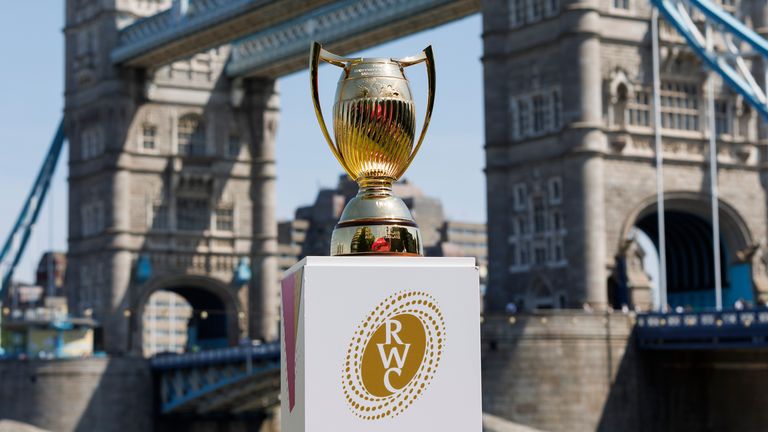
The redesigned Women’s Rugby World Cup trophy awaits its next champion – but who will claim it in 2025?
Knockout stage
The knockout stages ramp up the drama with quarter-finals, semi-finals, a third-place play-off, and the final.
Thanks to the semi-final split, if New Zealand and Canada top their pools, England could avoid both until the final – providing the Red Roses win their group.
Quarter-finals
September 13: Winner of Pool C vs Runner-up Pool D – Exeter, 1pm
September 13: Winner of Pool B vs Runner-up Pool A – Bristol, 4pm
September 14: Winner of Pool D vs Runner-up Pool C – Exeter, 1pm
September 14: Winner of Pool A vs Runner-up Pool B – Bristol, 4pm
Semi-finals
September 19: Winner QF1 vs Winner QF2 – Bristol, 7pm
September 20: Winner QF3 vs Winner QF4 – Bristol, 3.30pm
Bronze final
September 27: Runner-up SF1 vs Runner-up SF2 – Twickenham, 12.30pm
Final
September 27: Winner SF1 vs Winner SF2 – Twickenham, 4pm
Previous winners

Six-time champions New Zealand defend their title in England in 2025
Back-to-back defending champions New Zealand have claimed six of the nine Women’s Rugby World Cup titles, with England interrupting their dominance twice and the United States winning the inaugural edition in 1991.
1991 – United States
1994 – England
1998 – New Zealand
2002 – New Zealand
2006 – New Zealand
2010 – New Zealand
2014 – England
2017 – New Zealand
2021 – New Zealand
Red Roses 32-player World Cup squad
Forwards: Zoe Aldcroft (Gloucester-Hartpury, 63 caps), Lark Atkin-Davies (Bristol Bears, 66 caps), Sarah Bern (Bristol Bears, 71 caps), Hannah Botterman (Bristol Bears, 56 caps), Abi Burton (Trailfinders Women, 2 caps), May Campbell (Saracens, 3 caps), Mackenzie Carson (Gloucester-Hartpury, 21 caps), Kelsey Clifford (Saracens, 13 caps), Amy Cokayne (Sale Sharks, 83 caps), Maddie Feaunati (Exeter Chiefs, 15 caps), Rosie Galligan (Saracens, 24 caps), Lilli Ives Campion (Loughborough Lightning, 2 caps), Sadia Kabeya, (Loughborough Lightning, 21 caps), Alex Matthews (Gloucester-Hartpury, 75 caps), Maud Muir (Gloucester-Hartpury, 40 caps), Marlie Packer (Saracens, 110 caps), Morwenna Talling (Sale Sharks, 22 caps), Abbie Ward (Bristol Bears, 74 caps)
Backs: Holly Aitchison (Sale Sharks, 40 caps), Jess Breach (Saracens, 45 caps), Abby Dow (Unattached, 52 caps), Zoe Harrison (Saracens, 57 caps), Tatyana Heard (Gloucester-Hartpury, 29 caps), Natasha Hunt (Gloucester-Hartpury, 80 caps), Megan Jones (Trailfinders Women, 25 caps), Ellie Kildunne (Harlequins, 52 caps), Claudia Moloney-MacDonald (Exeter Chiefs, 35 caps), Lucy Packer (Harlequins, 31 caps), Helena Rowland (Loughborough Lightning, 39 caps), Emily Scarratt (Loughborough Lightning, 118 caps), Jade Shekells (Gloucester-Hartpury, 2 caps), Emma Sing (Gloucester-Hartpury, 8 caps)